
Upwork for Beginners: The Complete 2025 Playbook to Land Your First Client
Table of Contents
(Educational content — not legal or financial advice)
Breaking into freelancing can feel like a maze: dozens of job posts, hundreds of proposals, and a platform full of seasoned pros. Upwork for beginners doesn’t have to be overwhelming, though. With a clear positioning, a credible profile, strategic proposals, and a simple weekly rhythm, you can land that first contract, earn 5-star reviews, and build momentum you can scale.
This guide gives you everything you need: what matters on the platform (and what doesn’t), step-by-step profile setup, niche selection, portfolio shortcuts (even if you have no clients yet), proposal templates that get replies, pricing tactics, client communication scripts, and a 30-60-90 day plan to turn “newbie” into “booked.”
Why Upwork for beginners works (when you follow a system)
Platforms compress the distance between buyer and seller. Upwork already has clients with budgets, timelines, and intent. Your job is to make their choice easy by signaling specialization, reliability, and speed to clarity:
- Specialization: Clients buy outcomes, not generic skill lists.
- Reliability: Fast, clear replies and clean delivery win repeat work.
- Speed to clarity: Sharp questions and structured proposals reduce risk for the client. Upwork Academy
When you design your presence around these three ideas, the “beginner tax” shrinks fast.
The 5 truths nobody tells you about Upwork for beginners
- Niching beats shouting. Specific trumps loud; “Shopify product page copy that converts” beats “Copywriter.” Nielsen Norman Group on concise copy
- Your profile is a landing page. It must answer: “What result do I get? How fast? Why trust you?”
- Proposals are micro-sales pages. Short, tailored, and framed around the client’s outcomes.
- Small early wins compound. Two quick $100 jobs with 5-star reviews can unlock higher-budget searches.
- Rhythm beats willpower. A weekly pipeline routine outperforms sporadic bursts.
Positioning 101: Turn generic skills into a specific offer
Before you tweak a single profile field, decide what you sell:
- Who: industry or role (e.g., “B2B SaaS,” “real-estate agents”).
- What outcome: “launch a 1-page MVP,” “clean brand style guide,” “10 SEO articles/month.”
- Proof: credentials, mini-case bullets, or results (“grew CTR by 32%”).
- Process: 3–5 steps that show you’re in control.
Upwork for beginners works best when your offer is specific enough to be memorable but broad enough to find steady demand.
Profile Playbook: Build a page clients trust in 30 minutes
Treat your profile like a conversion page:
Photo
Neutral background, bright light, friendly and professional. Head and shoulders, direct eye contact.
Title (make it niche and outcome-oriented)
Create a Great Profile (Upwork)
- Good: Shopify Product Page Copywriter | CRO-Focused Descriptions
- Good: YouTube Thumbnail Designer | CTR-Boosting Thumbnails for Faceless Channels
- Avoid: Graphic Designer / Writer / Editor / VA
Overview (the 7-part structure)
Grammarly for clearer proposals
- Opening hook: Name the client’s pain and desired outcome in their words.
- Positioning line: Your specialization + market.
- Proof bullets: 2–4 short results, metrics if possible.
- Process snapshot: 3–5 steps (e.g., Discovery → Draft → Revisions → Final).
- Deliverables list: Exactly what they receive.
- Social proof or credentials: Platforms, tools, certifications.
- Call-to-action: Invite a micro-next-step (e.g., “Send your brief, I’ll reply within 4 hours.”)
Example opening:
You need product pages that turn browsers into buyers. I write conversion-first Shopify copy that raises add-to-carts without fluff.
Portfolio (even with zero clients)
Upwork for beginners often means “no proof yet.” Create proof:
- Spec work: 2–3 high-quality mock projects for real brands (label clearly as “spec”).
- Before/after samples: Redesign a weak landing page you found; show side-by-side.
- Process screenshots: Wireframes, drafts, checklists.
- Case mini-studies: 150 words: Context → Action → Outcome.
Skills & keywords
Use client language: “Shopify product description,” “thumbnail design,” “B2B blog writing,” specific tools (Figma, Webflow, HubSpot). Keywords raise your visibility in search.
Finding your lane: a practical niche framework
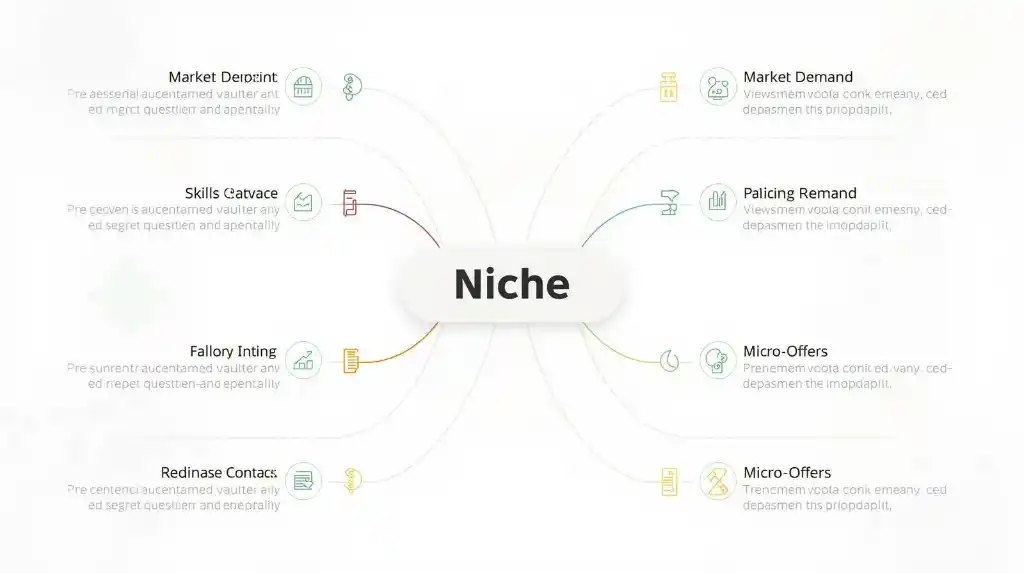
Pick a niche where three circles overlap:
- You can deliver well (skills you have or can sharpen fast).
- There’s clear demand (active job posts and decent budgets).
- You won’t hate your day (interest makes tedious parts tolerable).
Quick validation routine (30 minutes):
- Search Upwork for your intended niche (e.g., “YouTube thumbnail”).
- Check: number of recent posts, average budgets, and hire rates.
- Read 10 job posts; list recurring pains (e.g., “need higher CTR”).
- Mirror those pains in your profile and proposals.
Upwork for beginners becomes easier when you echo the market’s language.
Pricing for new profiles: signal value without scaring buyers
- Anchor with packages (not just hourly):
- Starter Blog Pack (3 articles, 800–1,000 words) → $XXX
- Thumbnail Trio (3 concepts + 2 rounds) → $XXX
- Offer a “first-project” scope to lower risk for both sides.
- Raise rates with milestones: every 3–5 five-star reviews, bump 10–15%.
Beware underpricing. Low rates can signal inexperience and attract the wrong clients.
Search, save, and filter: make the feed work for you
Upwork for beginners should create saved searches to reduce noise:
- Filters: Payment verified, 10–50 proposals, Client history: 1–9 hires, Budget: reasonable for your niche.
- Save 2–3 searches by service (e.g., “Shopify copy,” “YouTube thumbnails,” “B2B blog writer”).
- Turn on alerts. Apply within the first hour for visibility—but only if you can send a tailored pitch.
Proposal Blueprint: A 6-part message that gets replies
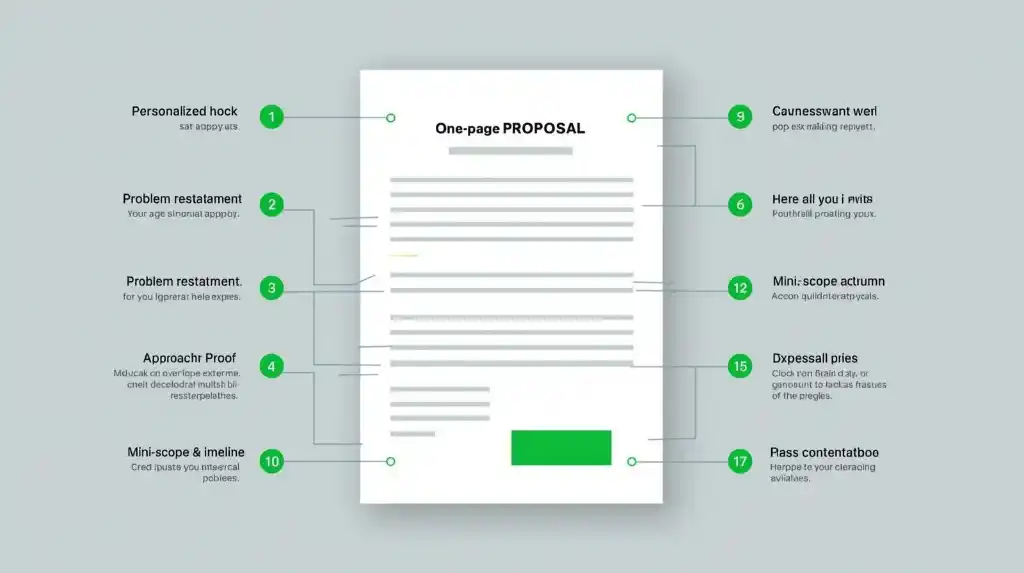
Subject line (for invitations):
Plan for your [result]: 3-step outline inside
Opening 2 lines (mirror the brief):
“You want [desired outcome] without [pain]. I deliver [result] using a simple process that keeps revisions light and timelines predictable.”
Micro-plan (3 bullets):
- Quick kickoff (questions + samples)
- First draft in 48–72 hours
- Two revision rounds, on me
Proof snack (1–2 lines):
“Recent work: 3 thumbnails that lifted CTR from 2.9% → 4.1%.”
Call-to-action:
“Share your brand assets and any references; I’ll reply with a draft outline today.”
Optional loom link (60–90s):
Walk through your approach. Personal beats generic.
Template (copy/paste and adapt)
Hi [Name],
I read your brief for [project]—you want [outcome] without [pain]. I help [industry/role] get [result] using a 3-step process:
- Kickoff call + clarifying questions (15 minutes)
- First draft in [X] hours/days
- Two revisions within 7 days
Recent work: [1-line proof/metric or spec sample].
If you share [assets/links], I’ll send a draft outline today and get started as soon as you approve.
Best,
[Name] | [Specialization]
Short. Relevant. Outcome-focused. That’s Upwork for beginners proposal gold.
Follow-up rhythm that wins without pestering
- T+24h: “Just checking you received my plan—happy to share a 60s Loom if useful.”
- T+72h: “If the timeline shifted, no problem. I have a slot [date/time]. Want me to hold it?”
- After award to someone else: “Congrats on moving forward! If anything changes, here’s a 2-point idea I didn’t include…”
Professional, helpful, never needy.
Messaging, milestones, and scope control
Once you’re in a chat:
- Clarify scope in writing. Deliverables, rounds of revisions, file formats, dates.
- Break into milestones. Easier approvals and faster payments.
- Use checklists. Clients love structure; it reduces back-and-forth.
- Handle scope creep gracefully:
“That’s outside the agreed scope, but I can add it as a mini-milestone for $XXX, delivery by [date].”
Upwork for beginners often stumble here—scope control keeps projects calm and profitable.
Portfolio power-ups you can build this week
Even one afternoon can upgrade your credibility:
- Create a 1-pager PDF with three samples per service (before/after visuals if relevant).
- Add a “process” image (timeline with steps) to your portfolio.
- Publish one short case bullet with a clear outcome (percentages or time saved).
Update your portfolio after every job with 1–2 screenshots and a 100–150-word caption.
Reviews, JSS, and social proof
- Ask at the right moment: after you deliver the final files and fix any tiny nits fast.
- Make it easy: “If you feel the project went well, a quick review mentioning [speed/clarity/result] would help a lot.”
- Respond to feedback: Always thank, and add a note about what you’ll keep doing or improve.
Upwork for beginners can rise quickly with a handful of specific, positive reviews.
Boundaries that earn respect (and better projects)
- Office hours: Put them in your profile and onboarding.
- Response SLAs: e.g., “I reply within one business day (usually much faster).”
- Rush policy: e.g., “25% rush fee for <48h turnarounds.”
- Revision window: keep it finite (e.g., “Within 7 days of delivery.”)
Boundaries protect quality and keep your calendar sane.
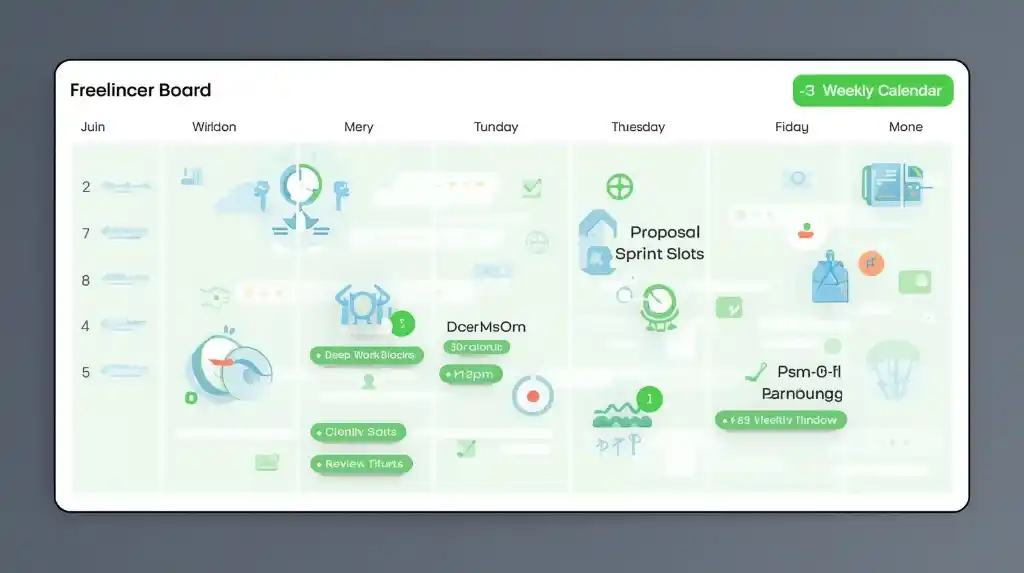
Time blocking for pipeline and delivery
A steady pipeline beats a busy week followed by silence:
- Daily (20–30 min): Review feed, send 2 tailored proposals, follow up on warm threads.
- Maker blocks (2–3 × 90 min): Deep work for delivery.
- Weekly review (30 min): What shipped? Win rate? Proposal tweaks?
Consistency is the secret lever in Upwork for beginners.
Common mistakes (and quick fixes)
- Generic proposals: Fix with a micro-plan and one line of proof.
- All-things-to-all-people titles: Replace with an outcome-based headline.
- Underpricing everything: Offer a small “starter scope,” not a low rate forever.
- Vanishing after you apply: Follow up politely; be the pro who “keeps the ball moving.”
- No portfolio: Build 2–3 spec projects now.
Case studies (composite but realistic)
1) The Thumbnail Designer
- Niche: Faceless YouTube channels.
- Offer: “3 CTR-tested thumbnails—2 rounds—48h.”
- Result: First two $100 jobs in week 1 → 5-star reviews → $450 pack by week 6.
2) The Shopify Copywriter
- Niche: Product pages for DTC skincare.
- Offer: “Starter pack: 5 SKUs with benefit-led bullets.”
- Result: Landed $300 trial → 30-SKU retainer at premium pacing.
3) The B2B Blog Writer
- Niche: SaaS lifecycle marketing.
- Offer: “Topic briefs + interviews + drafts in 5 days.”
- Result: From $0 to $2,800/mo across three clients in 90 days.
Each built clear offers, clean portfolios, and kept a daily proposal habit. That’s Upwork for beginners done right.
Templates you can steal (and adapt)
Profile title ideas
- Shopify Product Page Copywriter | Increase Add-to-Cart
- YouTube Thumbnail Designer | CTR-Focused Visuals
- B2B SaaS Writer | SEO + Subject-Matter Interviews
- Webflow Landing Page Designer | Launch in 7 Days
3-step process block
- Kickoff & brief (10–15 minutes)
- First draft in 48–72 hours
- Two revision rounds within 7 days
Handoff checklist (send with delivery)
- Final deliverables
- Source files / edit links
- Usage notes / style guide
- 7-day revision window
- “If you loved this” next steps (small upsell)
Tool stack that keeps you fast (and calm)
- Docs & briefs: Google Docs/Notion
- Async walkthroughs: Loom
- Design: Figma/Canva (thumbnails, mockups)
- Task manager: Trello/ClickUp (simple boards per client)
- Time tracking: Toggl/Clockify (improves estimates)
- Calendaring: Google Calendar (blocked maker/manager windows)
Lightweight tools + consistent routines = beginner advantage.
Security & professionalism basics
- Payments: Keep them inside Upwork for protection.
- Files: Share via view-only links until payment milestones clear.
- Privacy: Don’t reuse private client assets in public portfolios without explicit permission.
- Clarity: Write it down—scope, dates, rounds, formats.
Upwork for beginners with pro habits quickly stop feeling like beginners.
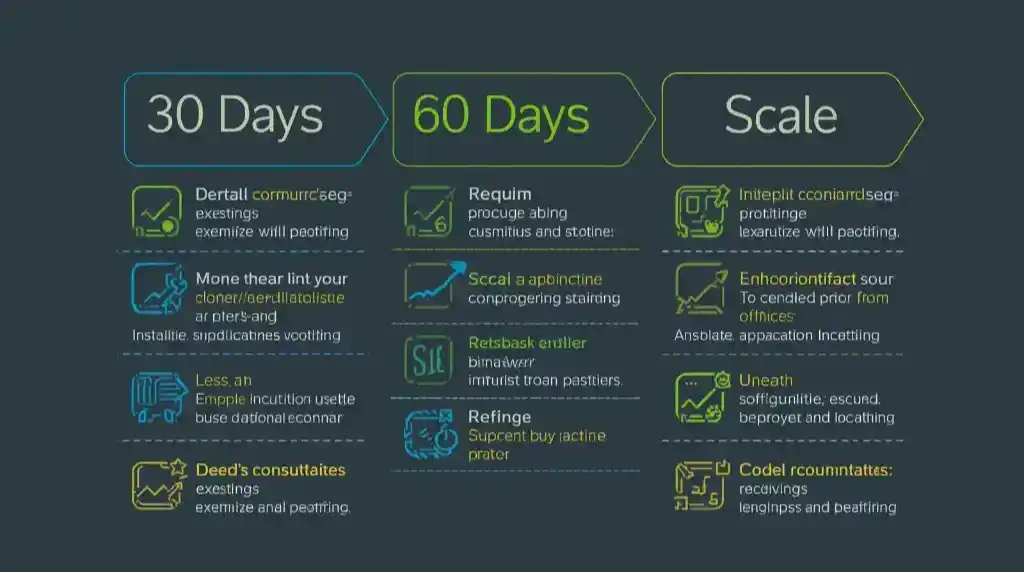
30-60-90 Day Plan: from zero to momentum
Days 1–30 — Install
- Choose 1–2 narrow offers (e.g., thumbnails, product pages).
- Write your profile with the 7-part overview.
- Create 2 spec projects + 1 process graphic.
- Save 3 filtered searches; apply to 2–3 posts/day with tailored proposals.
- Land 1–3 small jobs; deliver fast; ask for specific reviews.
Days 31–60 — Refine
- Raise package prices ~10–15% after 3–5 five-star reviews.
- Add one proof piece per week to your portfolio.
- Start a tiny upsell (e.g., “3 extra thumbnails” / “FAQ section add-on”).
- Track proposal win rate; iterate subject lines and first two sentences.
Days 61–90 — Scale
- Introduce a bigger offer (monthly blog pack / weekly thumbnail retainer).
- Set boundaries in a welcome PDF (hours, SLAs, revision rules).
- Push for repeat work: “Shall I pencil next week’s slot?”
- Trim the bottom 10% of your work to make room for better clients.
Three months of rhythm beats six months of hesitation.
FAQ: Fast answers for Upwork for beginners
Q: How many proposals per day?
A: 2–3 tailored proposals beat 10 generic ones. Quality > quantity.
Q: Hourly or fixed-price?
A: For first jobs, small fixed-price packages reduce risk for everyone. Add hourly for ongoing work later.
Q: What if I have no past clients?
A: Build spec projects. Show your process. Offer a small “starter scope.” Proof is proof, even if it’s self-initiated.
Q: How fast should I reply?
A: Under 12 hours is great; under 4 wins deals. Set expectations (office hours + SLAs) in your profile.
Q: How do I handle lowball offers?
A: Counter with a smaller scope, not a smaller rate: “We can start with [subset] for $XXX by Friday.”
Glossary (mini)
- JSS: Job Success Score; platform metric based on outcomes and feedback.
- SLA: Service Level Agreement (response or turnaround times).
- Spec work: Self-initiated sample to demonstrate capability.
- Milestone: A partial deliverable tied to partial payment.
Conclusion: The beginner advantage is real
Experts often overcomplicate. Beginners can be fast, focused, and easy to work with. Upwork for beginners is not about luck; it’s about clarity of offer, a credible profile, disciplined proposals, and punctual delivery. Start narrow, deliver brilliantly, ask for specific reviews, and raise your floor with each win.
Your next 10 minutes:
- Add one outcome-based sentence to your title.
- Draft a 3-step process block for your overview.
- Save one filtered search and apply to two posts with the template.
Then repeat tomorrow. Momentum > perfection.