

AI Tools for Productivity in 2025: The Complete Guide to Smarter Workflows, Faster Output, and Happier Teams
Table of Contents
Why AI Tools for Productivity Matter More Than Ever
The modern workplace is an always-on, cross-timezone, multi-platform maze. Even the most capable professionals are stretched by complex projects, meetings, compliance tasks, reporting deadlines, inbox overload, and constant context switching. Enter AI tools for productivity—a pragmatic, measurable way to reduce busywork, focus longer on high-impact tasks, and deliver better outcomes without burning out.
From AI writing tools that draft high-quality content in seconds, to AI for time management that optimizes your schedule and nudges you when you drift, to AI task automation that connects your apps and eliminates manual steps—this is not hype. It’s the difference between reactive work and smart work with AI: clear priorities, cleaner handoffs, faster throughput, and more creativity per hour.
In this guide you’ll learn:
- What categories of AI tools for productivity actually move the needle
- The best tools to try in 2025 (with do-follow links)
- Playbooks for freelancers, remote teams, managers, sales/marketing, developers, and HR
- A 30-60-90 integration roadmap, governance basics, and ROI formulas
- The next wave of productivity hacks using AI—and how to future-proof your setup
What Are AI Tools for Productivity? (Plain-English Overview)
AI tools for productivity are applications that use machine intelligence—language models, computer vision, recommendations, and predictive analytics—to save time, reduce errors, and multiply output. They can:
- Draft, summarize, or rewrite content (emails, proposals, briefs, docs)
- Automate repetitive tasks (copy/paste, file naming, routing, approvals)
- Transcribe and action meetings (notes, tasks, deadlines)
- Prioritize work using patterns in your calendar, habits, and deadlines
- Surface insights (What’s overdue? Where are the bottlenecks? What’s the next best action?)
In short, AI tools for productivity move you from “doing everything manually” to “co-piloting with targeted, reliable automations.”
Why AI Tools for Productivity Are Essential in 2025
- Deadline pressure & velocity. Markets move faster than humans can type. AI absorbs rote work so you can ship sooner.
- Hybrid, async collaboration. Distributed teams need shared clarity; AI tools for productivity standardize summaries, task creation, and status updates.
- Information overload. AI filters noise, surfaces what matters, and helps you “start at step three.”
- Quality at scale. AI consistency—style, tone, formatting, SOPs—means fewer revisions and rework.
- Sane workdays. AI for time management reduces context switching and protects deep-work hours.
Core Categories of AI Tools for Productivity (With Use Cases)
Each category below includes everyday scenarios to help you map tools to your workflow.
1) AI Writing Tools (Drafting, Editing, Summarization)
Use cases: Emails, proposals, briefs, blog posts, social copy, release notes, scripts, UX copy, knowledge base articles, job descriptions.
Value: Accelerate first drafts, enforce style guides, catch errors, create consistent templates.
Examples:
- Grammarly — real-time grammar, tone, and clarity suggestions.
- Jasper— brand-tuned copy generation, templates, and campaigns.
- Quillbot— paraphrasing, summarization, citations.

3) AI Communication Enhancers
Use cases: Inbox triage, thread summaries, suggested replies, channel hygiene, knowledge lookup.
Value: Fewer meetings, faster answers, reduced miscommunication.
Examples:
- Slack — AI search/summaries, huddles, workflows.
- Microsoft Teams — transcripts, summary notes, task extraction.
- Superhuman — AI email triage and reply assist.
4) Meeting Assistants (Transcription, Notes, Action Items)
Use cases: Accurate notes, task capture, summaries to absent stakeholders, follow-ups.
Value: Meetings become assets, not black holes.
Examples:
- Fireflies.ai — transcribe, summarize, and action follow-ups.
- Otter.ai — live notes, speaker tags, shareable summaries.
5) Workflow Automation Software (Glue Between Apps)
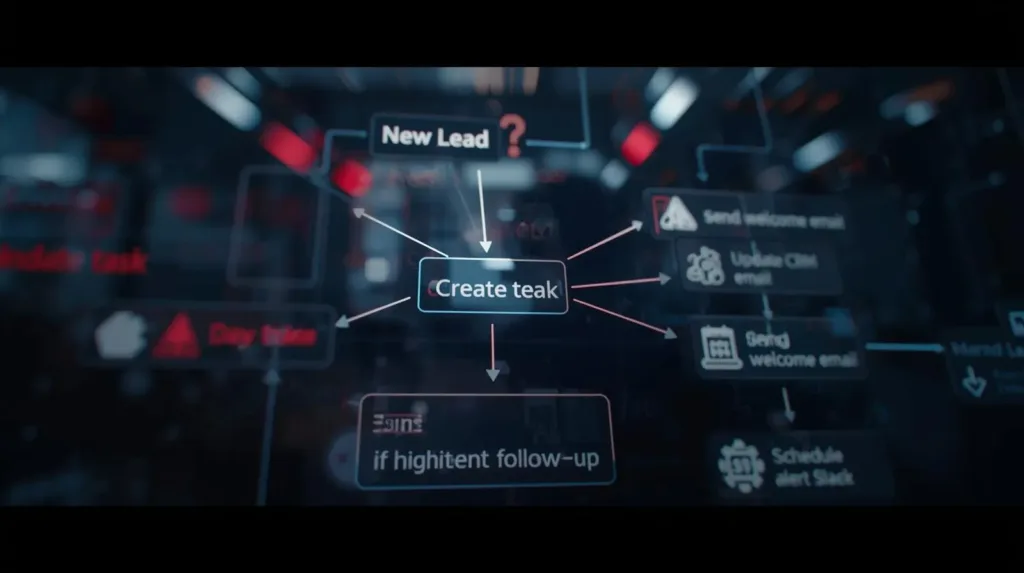
Use cases: “If X happens here, do Y over there” across Gmail, Sheets, CRM, PM tools, and cloud storage.
Value: Eliminates manual re-entry and human error; standardizes routine steps.
Examples:
- Zapier — 6,000+ app connections, multi-step automations.
- Make (formerly Integromat) — visual, logic-rich workflows.
- IFTTT — simple triggers across services and devices.
6) Knowledge Search & Summarization
Use cases: Find answers inside docs, wikis, tickets, calls; create reliable summaries.
Value: Shortens research time, reduces duplicate work, standardizes responses.
Examples:
- Notion AI — summarize pages, generate doc scaffolds.
- Confluence AI — quick answers from spaces.
7) Analytics, Forecasting & Insights
Use cases: Spot bottlenecks, forecast workloads, predict customer behavior, surface trends.
Value: Decide with data, not instinct; prevent slowdowns before they happen.
Examples:
The Best AI Tools for Productivity in 2025 (Do-Follow Reference List)
Keep your stack small, integrated, and aligned to outcomes. All links are ordinary do-follow.
- Writing & Content: Grammarly , Jasper, Quillbot
- Notes & Knowledge: Notion , Evernote
- Task & Time: Todoist, Trello, Motion
- Meetings: Otter.ai, Fireflies.ai
- Communication: Slack, Microsoft Teams
- Automation: Zapier, Make, IFTTT
- Project & Delivery: Asana, ClickUp, Jira
- Docs & Collaboration: Google Workspace, Microsoft 365
- Video & Async: Loom, Vimeo Record
- Dashboards & BI: Tableau, Power BI
How to Choose AI Tools for Productivity (Decision Framework)
- Start with outcomes. “We want to reduce drafting time by 50%,” “Cut meeting hours by 30%,” “Ship weekly reports automatically.”
- Map your flow. Where is the friction? Intake → draft → review → approval → handoff → report.
- Pick one lever per step. Drafting (writing tool), approvals (automation), meetings (assistant), reporting (BI).
- Integrate first, then expand. Favor tools that connect cleanly (SSO, APIs, webhooks).
- Pilot with a small team. 2–4 weeks, real work, real KPIs.
- Measure & iterate. If it doesn’t save time or improve quality in 30–45 days, pivot.
Best Practices for Integrating AI Tools for Productivity
A) Clean Processes First
Document your “happy path.” AI amplifies what you run—good or bad. Tighten handoffs, naming, tags, and quality bars.
B) Start in the Middle of the Pain
Pick the one area that hurts daily (e.g., follow-up emails, meeting notes, reporting). Win there; expand outward.
C) Train the Humans
Short, role-based training > long generic demos. Provide templates, examples, and “when to use / when not to use.”
D) Build an Automation Library
Create foldered, named, versioned AI task automation recipes. Treat them like code.
E) Governance, Privacy, & Access
Define data types allowed in each tool, retention, audit trails, and who can connect what to where.
F) Maintain a Single Source of Truth
Even with AI tools for productivity, pick one system of record for tasks, docs, and decisions. Link out, don’t duplicate.
Playbooks: AI Tools for Productivity by Role
Freelancers & Solopreneurs
- Stack: Grammarly or Jasper, Notion, Todoist, Motion, Zapier, Otter, Loom.
- Wins: Faster drafts, cleaner proposals, auto-generated invoices, transcribed calls, clear client updates.
- Tip: Productize: make checklists + automations you can reuse for every client.
Remote & Hybrid Teams
- Stack: Slack/Teams, Notion/Confluence, Asana/ClickUp, Otter/Fireflies, Zapier/Make, BI (Tableau/Power BI).
- Wins: Thread summaries, handoff checklists, auto status updates.
- Tip: Replace weekly “status” meetings with async Loom + AI summary.
Managers & Team Leads
- Stack: Calendar + Motion, BI dashboards, meeting assistants, task tool with AI insights.
- Wins: Calendar rebuilt around priorities, fewer synchronous meetings, real capacity visibility.
- Tip: One planning block/week + automated dashboard snapshot = 2–4 hours saved.
Sales & Marketing
- Stack: Jasper + Grammarly, CRM + Zapier, Calendly, Loom, Otter, attribution dashboards.
- Wins: Faster proposals, follow-ups, collateral; automatic contact enrichment; meeting notes to CRM.
- Tip: Pre-build 5–7 message frameworks and let AI adapt them per persona/segment.
Product & Engineering
- Stack: Jira + automation rules, meeting assistants, spec templates in Notion, Slack workflows.
- Wins: Clean specs, better sprint hygiene, fewer blockers.
- Tip: Turn sprint reviews into digestible, automated summaries for stakeholders.
HR & Operations
- Stack: Notion/Confluence for SOPs, Otter/Fireflies for interviews, Zapier for onboarding flows.
- Wins: Standardized job posts, predictable onboarding, improved policy access.
- Tip: Auto-trigger welcome packets, account provisioning, and training plans.
Distraction Defense: Make Focus the Default
- Protect deep work: Two 60–90-minute blocks/day.
- Smart notifications: Batch inbox and chat twice/day; use status (“Deep work; back at 1pm”).
- Website blockers: Mute news/social during maker blocks.
- Pomodoro rhythm: 25/5 or 50/10 cycles; log 2 minutes of notes after each sprint.
The best AI tools for productivity won’t help if you’re interrupted every seven minutes.
Governance, Privacy, and Ethics for AI Tools for Productivity
- Data boundaries: What data can/can’t enter which tool? Customer PII? Financial docs?
- Model clarity: If an AI creates content, must human review before external sharing?
- Audit trails: Who changed what, when, and why?
- Bias watch: For hiring or scoring tools, build periodic fairness checks.
- Offboarding: Revoke access and clean API keys when roles change.
Governance keeps smart work with AI safe, compliant, and sustainable.
Measure ROI: Proving AI Tools for Productivity Work
Time-saved ROI (monthly): ROI=(Hours Saved×Hourly Cost)−Tool CostTool Cost×100%\text{ROI} = \frac{(\text{Hours Saved} \times \text{Hourly Cost}) – \text{Tool Cost}}{\text{Tool Cost}} \times 100\%ROI=Tool Cost(Hours Saved×Hourly Cost)−Tool Cost×100%
Quality ROI (proxy):
Fewer revisions + shorter cycle time + higher CSAT/employee NPS.
Adoption KPIs:
% active users weekly, automations run, tasks created from AI, meeting hours reduced, time-to-first-draft.
If AI tools for productivity don’t move a KPI within 30–45 days, revisit fit or training.
A 30-60-90 Day Roadmap to Install AI Tools for Productivity
Days 1–30 (Install)
- Choose one pain point; run a pilot with 3–5 people.
- Implement one tool per outcome (e.g., Otter for notes, Jasper for drafts, Zapier for handoffs).
- Track hours saved and errors reduced.
- Create micro-training and 3–5 templates.
Days 31–60 (Refine)
- Expand to the adjacent step in the workflow (e.g., from drafts → approvals → publishing).
- Build your AI task automation library (naming, versions).
- Add governance basics (data boundaries, access roles).
- Publish a weekly “wins & lessons” digest.
Days 61–90 (Scale)
- Roll out to the next team or function.
- Connect reporting: dashboard for time saved, meeting reduction, and on-time delivery.
- Review tool overlap; cut bloat.
- Standardize onboarding with templates + short videos.
Troubleshooting: When AI Tools for Productivity Don’t Stick
- Symptom: People revert to old habits.
Fix: Short training, better templates, visible wins. - Symptom: Automations break.
Fix: Use fewer tools, add error alerts, version control, owner assigned. - Symptom: Quality dips.
Fix: Tighten prompts, add brand/style guides, enforce human review. - Symptom: “We’re busy, no time to change.”
Fix: Start with one 30-minute win/week; let success create pull.
Future of AI Tools for Productivity (2025 and Beyond)
- Agentic orchestration: Multi-step AI agents that plan → act → verify across apps.
- Embedded everywhere: The best AI tools for productivity will disappear into UI, commands, and shortcuts.
- Personalization: Tools learn your voice, calendar rhythm, and standards.
- Compliance-aware AI: Built-in privacy, audit, and security for regulated teams.
- Human-in-the-loop by design: Faster drafting + purposeful human judgment = quality without risk.
The future is fewer tabs, smarter defaults, and work that starts closer to “done.”
FAQ: Straight Answers About AI Tools for Productivity
Q1: Will AI tools replace my team?
No. They replace repetitive steps, not judgment, strategy, or empathy. The best results pair AI tools for productivity with human review.
Q2: How do I avoid tool sprawl?
Choose one tool per outcome, integrate tightly, and prune quarterly.
Q3: Is daily compounding of small wins real?
Yes. Ten saved minutes/day per person = ~40 hours/year—times your headcount.
Q4: What’s the fastest first win?
Meeting summaries to tasks + automated follow-ups. Next is drafting repetitive emails with AI.
Q5: How much training do we need?
Start with 30–45 minutes per role + cheat sheets. Reinforce with weekly tips.
Conclusion: Smart Work with AI Is a System, Not a Slogan
AI tools for productivity are not silver bullets. They are force multipliers for teams with clear goals, simple processes, and a willingness to learn. Start small: one meeting assistant, one drafting helper, one AI task automation. Measure time saved, celebrate the wins, and expand carefully. In 90 days, you’ll wonder how you ever worked without them.