Artificial Intelligence News Today: Why It’s Trending in the USA
Table of Contents
Introduction
Artificial intelligence news is spiking in the United States because AI has shifted from a futuristic concept to an operational layer that touches pricing, customer support, content production, and data security. In a single week you’ll see agentic tools that complete tasks inside apps, billion-dollar infrastructure bets, and new privacy policies—each headline capable of changing today’s decisions.
This guide turns headline-chasing into a system for decisions and small experiments. You’ll get a 90-second vetting framework for any AI announcement, a 25-minute weekly routine to track what matters, and clear KPIs to measure impact—so you know when to deploy a tool, when to iterate, and when to ignore the noise.
Why artificial intelligence news is trending in the USA now
Faster product cycles: Weekly launches of agentic tools, multimodal features, and cheaper inference push artificial intelligence news into mainstream tech and business media.
Infrastructure bets: Data-center expansions and chip supply deals signal durable capacity—making artificial intelligence news relevant to finance, IT, and operations teams.
Enterprise adoption: Sales, support, and legal teams are piloting AI for summarization, search (RAG), and workflow automation; results feed back into artificial intelligence news coverage.
Governance & IP debates: Privacy, data retention, and copyright cases keep artificial intelligence news on the front page, shaping procurement decisions.
Takeaway: Treat artificial intelligence news as an input to action. If a headline doesn’t map to a measurable use case this month, archive it—don’t chase it.
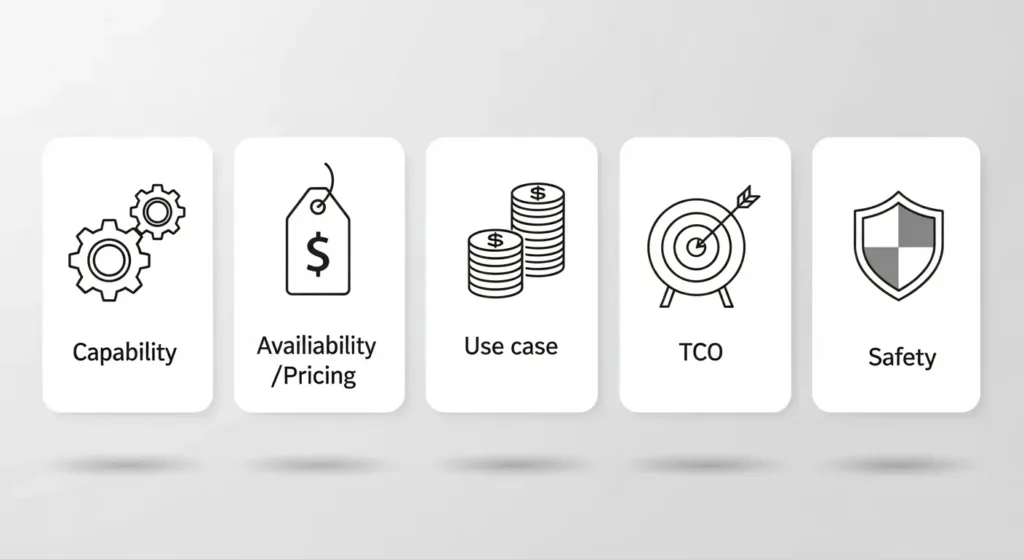
The 90-Second Framework to Vet any artificial intelligence news Item
1) Capability (What is it, exactly?)
Is it an agent that completes steps inside apps, a multimodal upgrade, or a cost/latency improvement?
Expected outputs: text, code, files, or automated workflows.
Litmus test: can you describe the capability in one sentence a stakeholder understands?
2) Availability & Pricing (Can you use it today?)
Status: General Availability (GA) vs. waitlist vs. demo-only.
Pricing clarity: tokens/calls, rate limits, SLA.
Green flag: a free tier or sandbox to validate claims within hours.
3) Map to Your Use Case (Where does it pay off?)
Pick one workflow the news could improve this month: e.g., contract summaries, customer replies, or internal search.
Success hypothesis: “Reduce task time by 30% while keeping accuracy ≥ baseline.”
4) Total Cost of Ownership (What does it really cost?)
Integration time, data plumbing, governance, monitoring, rollback plan.
Hidden costs: prompt/retrieval engineering, human review, and training time.
Evidence: logs, permissioning, and reproducibility for regulated teams.
Quick Decision Rule
If the artificial intelligence news item is GA, has clear pricing, maps to one measurable use case, and you can enforce basic guardrails ⇒ run a 2-week pilot. Otherwise, park it on a “watch later” list and move on.
Smart Adoption Index (0–10)
Score each headline; ship pilots only if ≥ 7/10.
+3: Available now (not “coming soon”)
+2: Transparent pricing + SLA
+2: Free trial/sandbox with docs and code samples
+2: Native integrations with your stack
+1: Built-in audit logs/permissions
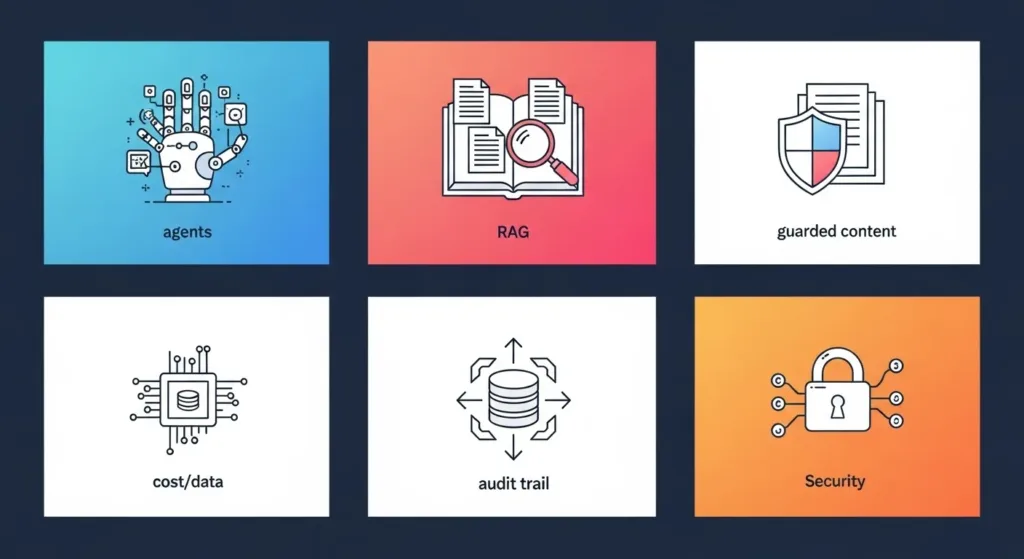
Where the value concentrates in artificial intelligence news (5 practical themes)
1) AI Agents
Agents execute real steps inside apps and the browser (form-filling, file uploads, screenshots as evidence). Why it matters to artificial intelligence news: shifts stories from “language ability” to task completion you can measure. Quick win: cut repetitive workflow time by 30–60% while keeping an auto-generated audit trail.
2) Enterprise Search / RAG
Connect models to your docs and return answers with citations. Relevance to artificial intelligence news: every RAG upgrade that improves retrieval precision boosts trust for legal, support, and ops. Quick win: find the right document in seconds instead of hours; reduce human review cycles.
3) Guarded Content Generation
Refusal rules, required sources, and style constraints for consistent outputs. Why it frequently appears in artificial intelligence news: it converts directly into faster blogs, emails, and product pages. Quick win: publish “edit-ready” drafts faster and shrink editing time significantly.
4) Cost & Data Engineering
Match model size to task, compress context, and split read/write steps. Link to artificial intelligence news: “cheaper/faster” announcements matter only if they lower your cost per 1,000 tokens in real workflows. Quick win: reduce serving costs 20–50% without visible quality loss by routing easy tasks to lighter models.
5) Security & Governance
Data sensitivity tiers, fine-grained permissions, logs, and output red-teaming. Why it dominates artificial intelligence news: it’s the gatekeeper for broad enterprise adoption in the US market. Quick win: pass audits faster and unblock organization-wide rollouts.
Executive takeaway: let artificial intelligence news be the input for choosing one of these tracks this month. Run a short pilot with two clear metrics: task time and cost per 1,000 tokens.
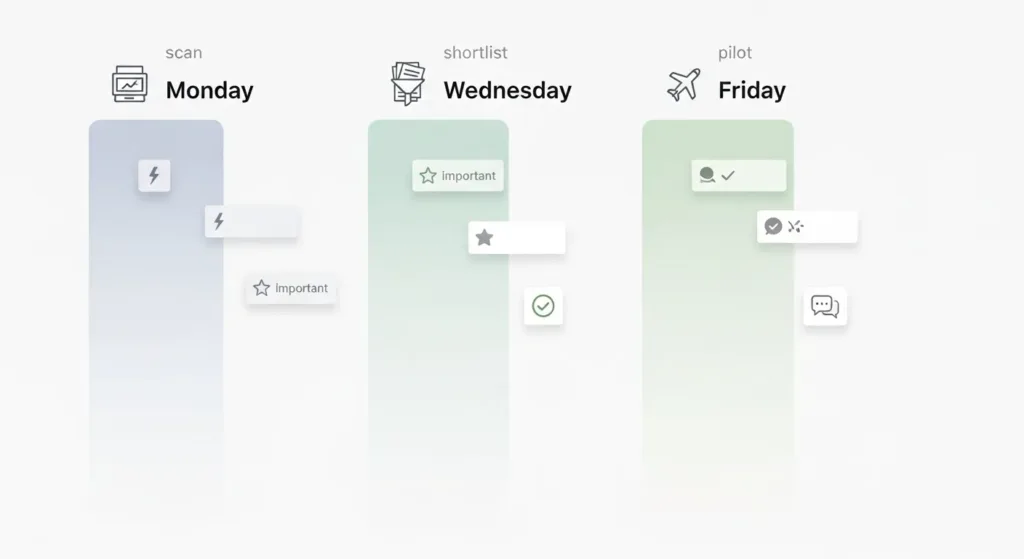
A 25-minute weekly system to track artificial intelligence news (without drowning in tabs)
Monday (10 min) — Source scan
Skim two high-signal hubs: Reuters’ AI page and The Verge’s AI section to capture headlines with enterprise impact. Prioritize items that affect pricing, availability (GA vs. waitlist), or governance. Reuters+1
Wednesday (10 min) — Shortlist + plan
From your feed, pick 2 headlines that map to a measurable use case (e.g., contract summaries, RAG search, agentic form-filling).
Write a one-sentence hypothesis for each: “This artificial intelligence news item could cut task time by 30% while maintaining baseline accuracy.”
Friday (5 min) — Mini pilot setup
Create a 1-week micro-pilot for one headline only. Define: success metric (task time, cost per 1,000 tokens), guardrails (refusal rules, citations), and rollback steps.
Log results in a shared doc; archive everything else. If it’s not actionable now, it’s reference material—not a priority.
Optional, 5 extra minutes — Deeper read
If a story looks pivotal, open the full Reuters write-up or a well-reported explainer from The Verge to validate claims before you commit engineer time. Reuters+1
Outcome: by time-boxing 25 minutes a week, you keep artificial intelligence news aligned with delivery: ship pilots when evidence is strong, iterate when partial, ignore when speculative.
Track TCO KPI; ring-fence scope; kill fast if no lift
Governance risk
Data retention/IP uncertainty
Guardrails, red-team checks, DPA/SLA in place
Vendor lock-in
Proprietary tooling hard to unwind
Abstraction layer; dual-vendor strategy for core flows
Executive tip: If a piece of artificial intelligence news doesn’t clear four checks—(1) GA today, (2) transparent pricing, (3) one measurable use case, (4) enforceable guardrails—archive it and move on.
FAQs about artificial intelligence news (clear, concise, practical)
1) Do I always need the largest model I see in artificial intelligence news? No. Right-size the model to the task. Use lighter models for classification, routing, and summarization; reserve larger models for complex reasoning. This keeps quality steady while cutting latency and cost per 1,000 tokens.
2) How do I separate hype from reality when artificial intelligence news breaks? Run the 90-second check: capability → availability/pricing → one use case → TCO → safety. If it’s not GA, has fuzzy pricing, or can’t map to a measurable workflow this month, archive it.
3) What’s the fastest way to pilot something from artificial intelligence news? A 2-week micro-pilot: pick one workflow, set two KPIs (task time, cost/1k tokens), add guardrails (refusals, citations), and define a rollback. Ship with a tiny cohort before scaling.
4) How can I reduce hallucinations noted in artificial intelligence news stories? Ground outputs with RAG (trusted sources), require citations, and enforce refusal rules when context is insufficient. Track a “quality/uplift” score so editors can flag gaps.
5) Is my data safe when I act on artificial intelligence news? Check data retention, region, and access. Demand logs, permissioning, and a DPA/SLA. For sensitive work, keep retrieval indexes private and redact or tokenize PII.
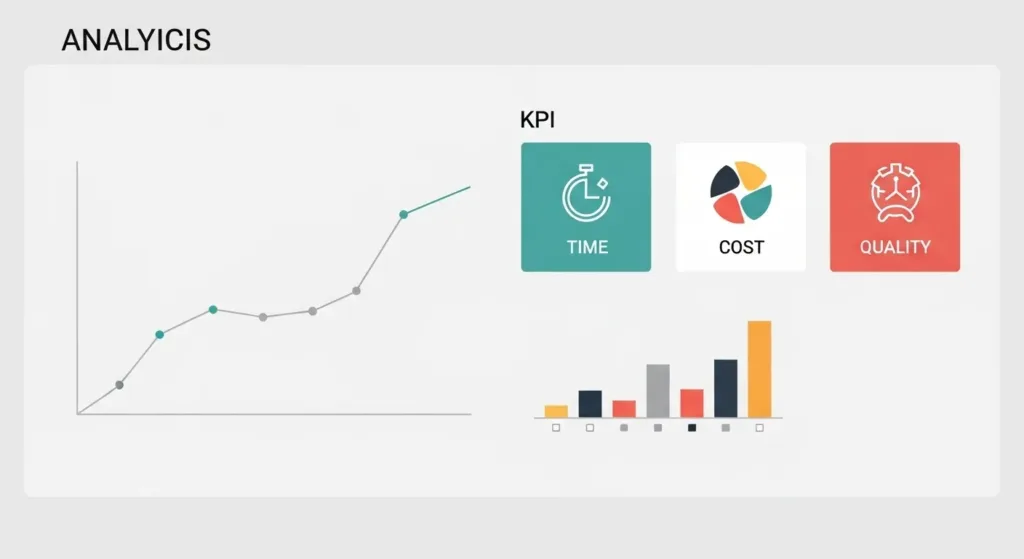
6) What KPIs prove that artificial intelligence news turned into value? Time per task, cost per 1,000 tokens, first-contact resolution/self-serve rate, human review rate, compliance pass rate, and time-to-value. Report weekly in one page.
7) How do AI agents mentioned in artificial intelligence news differ from chatbots? Agents take actions (click, fill, upload) across steps; chatbots mostly return text. Judge agents by completion rate, audit logs, and error recovery—not just eloquence.
8) When should I ignore artificial intelligence news? If it fails any of the four checks—(1) GA today, (2) transparent pricing, (3) one measurable use case, (4) enforceable guardrails—park it. Opportunity cost is real.
9) How do I avoid vendor lock-in as I follow artificial intelligence news? Use an abstraction layer for model calls, keep prompts/evals in version control, and maintain a dual-vendor plan for critical flows (search, agents, serving).
10) What’s a sane monthly cadence for teams tracking artificial intelligence news? Four micro-pilots max per month, one winner promoted to production, and a monthly review to retire underperformers. Keep the backlog tidy and evidence-based.
Conclusion + Next steps (anchored on artificial intelligence news)
Bottom line: artificial intelligence news is valuable only when it becomes measurable action. Use the 90-second vetting checklist, keep a 25-minute weekly rhythm, and track a small KPI set so you can deploy, iterate, or ignore with confidence.
Next steps (14-day plan)
Pick one workflow clearly touched by current artificial intelligence news (e.g., contract summaries, RAG search, agentic form-filling).
Write a one-sentence hypothesis: “Cut task time by 30% while maintaining baseline quality.”
Set guardrails: refusal rules, citation requirements, audit logs, and permission scopes.
Run a 2-week micro-pilot on a narrow sample (20–50 items).
Measure three KPIs: task time, cost per 1,000 tokens, human review rate.
Decide decisively: promote if targets are met; refine if close; archive if not.
Document learnings in a shared page titled “What we learned from this week’s artificial intelligence news,” and feed those lessons into the next pilot.
Cookie Consent
We use cookies to improve your experience on our site. By using our site, you consent to cookies.
This website uses cookies
Websites store cookies to enhance functionality and personalise your experience. You can manage your preferences, but blocking some cookies may impact site performance and services.
Essential cookies enable basic functions and are necessary for the proper function of the website.
Name
Description
Duration
Cookie Preferences
This cookie is used to store the user's cookie consent preferences.
30 days
These cookies are needed for adding comments on this website.
Name
Description
Duration
comment_author
Used to track the user across multiple sessions.
Session
comment_author_email
Used to track the user across multiple sessions.
Session
comment_author_url
Used to track the user across multiple sessions.
Session
Statistics cookies collect information anonymously. This information helps us understand how visitors use our website.
Google Analytics is a powerful tool that tracks and analyzes website traffic for informed marketing decisions.
Contains information related to marketing campaigns of the user. These are shared with Google AdWords / Google Ads when the Google Ads and Google Analytics accounts are linked together.
90 days
__utma
ID used to identify users and sessions
2 years after last activity
__utmt
Used to monitor number of Google Analytics server requests
10 minutes
__utmb
Used to distinguish new sessions and visits. This cookie is set when the GA.js javascript library is loaded and there is no existing __utmb cookie. The cookie is updated every time data is sent to the Google Analytics server.
30 minutes after last activity
__utmc
Used only with old Urchin versions of Google Analytics and not with GA.js. Was used to distinguish between new sessions and visits at the end of a session.
End of session (browser)
__utmz
Contains information about the traffic source or campaign that directed user to the website. The cookie is set when the GA.js javascript is loaded and updated when data is sent to the Google Anaytics server
6 months after last activity
__utmv
Contains custom information set by the web developer via the _setCustomVar method in Google Analytics. This cookie is updated every time new data is sent to the Google Analytics server.
2 years after last activity
__utmx
Used to determine whether a user is included in an A / B or Multivariate test.
18 months
_ga
ID used to identify users
2 years
_gali
Used by Google Analytics to determine which links on a page are being clicked
30 seconds
_ga_
ID used to identify users
2 years
_gid
ID used to identify users for 24 hours after last activity
24 hours
_gat
Used to monitor number of Google Analytics server requests when using Google Tag Manager