
Table of Contents
1. Introduction
If you’re eyeing exposure to the next frontier in telecom, AST SpaceMobile (ticker: ASTS) is one of the names you’ll come across. It promises to deliver 5G connectivity directly from space to standard smartphones—no special hardware needed—especially to areas poorly served by terrestrial networks. That makes the vision exciting. But as with many high‑potential plays in space tech, it comes with significant risks.
This article breaks down how ASTS works, where its opportunities lie, what could go wrong, and how it compares to competitors like Starlink and Iridium. Whether you’re a beginner in investing in satellite tech or just curious, you’ll get a clearer picture of whether ASTS belongs in your portfolio.
2. What is AST SpaceMobile & Its Technology
2.1 The Vision: 5G from Space
AST SpaceMobile aims to build a space‑based cellular broadband network. The goal: allow existing, unmodified smartphones to connect to satellites in low Earth orbit (LEO), especially where terrestrial cell towers are sparse or nonexistent.
Main components:
- Large communications arrays deployed on satellites (BlueWalker / BlueBird series).
- Partnerships with mobile network operators (MNOs) to use spectrum and integrate service.
- Regulatory approvals and experimental licenses for transmitting over certain frequency bands.
2.2 Key Milestones & Satellites
- AST has already launched prototypes such as BlueWalker 1 (2019) and BlueWalker 3 (2022), the latter having a very large deployable communications array.
- It has started deploying commercial satellites (BlueBirds). For instance, the first five commercial satellites (BlueBird 1‑5) have been launched.
- They’ve made some high‑profile demos (e.g., “world’s first video satellite call” using standard phones via satellite with Vodafone) as proof of concept.
3. Investment Potential
3.1 Market Opportunity & Demand
- There is a large market gap: billions of people around the world still lack stable, high‑speed mobile broadband, especially in remote or underserved regions. AST aims to address that gap.
Market potential – Barron’s - The Low Earth Orbit (LEO) satellite communications market is getting investor attention: it’s projected to be a multi‑billion dollar opportunity, especially with 5G‑from‑space and direct‑to‑device (D2D) use cases.
3.2 Partnerships & Strategic Deals
- ASTS has struck deals with major telecom operators, including Vodafone, AT&T, Verizon, which gives it access to spectrum, distribution channels, and existing subscriber bases.
- Regulatory approvals and trials are underway (or granted) in various regions, which helps reduce some uncertainty.
3.3 Revenue Prospects
- ASTS is still in early stages of commercial revenue, but once enough satellites are operational (Bluebird 1‑5 in active service), there’s potential for significant growth.
- If subscription or usage fees from underserved areas prove viable, it could unlock new recurring revenue. But margins, pricing, and customer uptake are all uncertainties.
Capital.com beginner guide
Passive Income Ideas 2025
4. Risks & Challenges
4.1 Financial Burn & Capital Requirements
- ASTS reports large operating losses (for example, its Q1 2025 operating loss was ~$63 million) driven by heavy R&D, manufacturing, and launching expenses.
- Building, launching, and operating satellites is expensive; cash burn is a real concern. The company has disclosed many risk factors related to finance & corporate risks.
4.2 Technical & Execution Risks
- Scaling up from prototypes and demo satellites to full commercial service is non‑trivial. Issues could include reliability, latency, satellite manufacturing, launch delays, operational failures.
- The technology of delivering high bandwidth from LEO directly to phones (without special hardware) is still being proven in many parts.
4.3 Regulatory, Spectrum & Competition Risks
- ASTS needs regulatory approvals across many countries, and spectrum licenses are crucial. Delays or denials can significantly impact progress.
- Competition is intensifying. Starlink (SpaceX) is aggressive, and companies like Iridium, Globalstar, even upcoming D2D and NTNs (non‑terrestrial networks) may pose threats. Pricing, coverage, and brand strength count.
- Also, customer adoption may be slow if the pricing of service is high (because of the costs), or if terrestrial networks improve or expand.
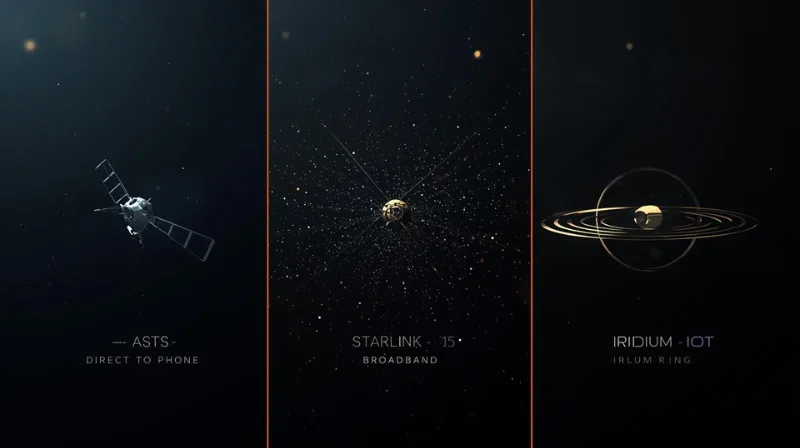
5. Comparison: ASTS vs Starlink vs Iridium
| Feature | AST SpaceMobile (ASTS) | Starlink (SpaceX) | Iridium Communications |
|---|---|---|---|
| Service Goal | Direct‑to‑standard phones, 4G/5G from space, covering dead spots and underserved regions. | Satellite internet (broadband), terminals needed currently; expanding into direct‑to‑device / mobile phone domain. | Satellite voice & data, strong in IoT, messaging; serving remote, gov/military use cases. |
| Constellation Status | Just beginning commercial deployments (BlueBirds); few satellites operational, many in development. | Very large constellation already partially operational; high capacity, broad coverage. | Existing constellations in service; fairly established. |
| Revenue & Business Model | High upfront CapEx, dependency on MNO partnerships, still early revenue; long horizon to breakeven. | More mature revenue streams, better infrastructure, direct service + terminal sales. | More stable cash flow from existing services (IoT, government contracts), less speculative upside but more predictability. |
| Risk Profile | High risk: execution, financing, regulatory, adoption risks; high volatility. | Also risky, especially for scaling and regulatory; but more tested in the field. | Lower risk, but slower growth; less likely to deliver explosive returns. |
| Competitive Edge / Differentiator | Service directly to phones without special handsets; first mover in “space cellular broadband.” Big telecom partners. | Massive deployment, brand recognition, more R&D & scale economies; SpaceX’s experience. | Reliability, established customer base, niche in IoT/mission critical services. |
6. Is ASTS Right for Investors? (Who It Might Suit)
If you are:
- Comfortable with high risk and volatility, and you believe in long‑term disruption in telecom/satellite tech, ASTS could be attractive.
- Looking for speculative growth, not income or steady cash flows.
- Willing to wait several years (2‑5+) for the full business model to mature and revenue to ramp up.
On the flip side, if you prefer:
- More stable, dividend paying stocks
- Companies with proven revenue and profit history
- Lower risk
… then established players like Iridium or even Starlink/SpaceX‑related investments may suit you better.
7. Conclusion & Key Takeaways
- AST SpaceMobile is ambitious: its technology could transform how mobile broadband is delivered globally, especially to under‑served areas.
- There is real upside, especially with big telecom partners, regulatory progress, and successful satellite deployment.
- But the risks are non‑trivial: costs, competition, execution delays, regulatory hurdles, and uncertain customer adoption.
- Compared with Starlink & Iridium: ASTS offers more upside (if everything goes right), but also more downside. Iridium is safer; Starlink is somewhere in between.
Next Steps & What to Watch
- Monitor ASTS’s upcoming satellite launches and whether BlueBird 1‑5 reach full operation.
- Watch for contracts or pricing announcements with mobile network operators.
- Regulatory decisions, spectrum licensing, and any delays in approvals.
- Quarterly financials: cash burn, loss margins, and revenue growth.
- Competitive moves: what Starlink, Iridium, and new entrants are planning in direct‐to‐device services.
Frequently Asked Questions (FAQs)
- When will ASTS become profitable?
There is no guaranteed timeline. Profitability depends on successful deployment of many satellites, subscriber adoption, pricing execution, and controlling costs. It could take several years. - Do I need a special phone to use ASTS’s service?
No. ASTS claims its service will work with existing, unmodified smartphones, which is a key differentiator. - How does ASTS handle competition from Starlink?
Starlink has scale, experience, and a large constellation already in orbit. ASTS’s advantage is its focus on standard smartphone integration and partnerships with telecom operators; but commerce competitiveness depends on pricing, regulatory environment, and service reliability. - What are the biggest risks?
The biggest risks are financial (running out of funds), technical failures, regulatory delays, competition, and that the business may take much longer to scale than expected. - Is the satellite internet market growing?
Yes, fast. Investors are increasingly seeing LEO, direct‑to‑device, and non‑terrestrial networks (NTNs) as growth areas, especially for bridging connectivity gaps globally.