Table of Contents
This is educational content, not financial advice.
Introduction: A Plot Twist for a Silicon Valley Icon
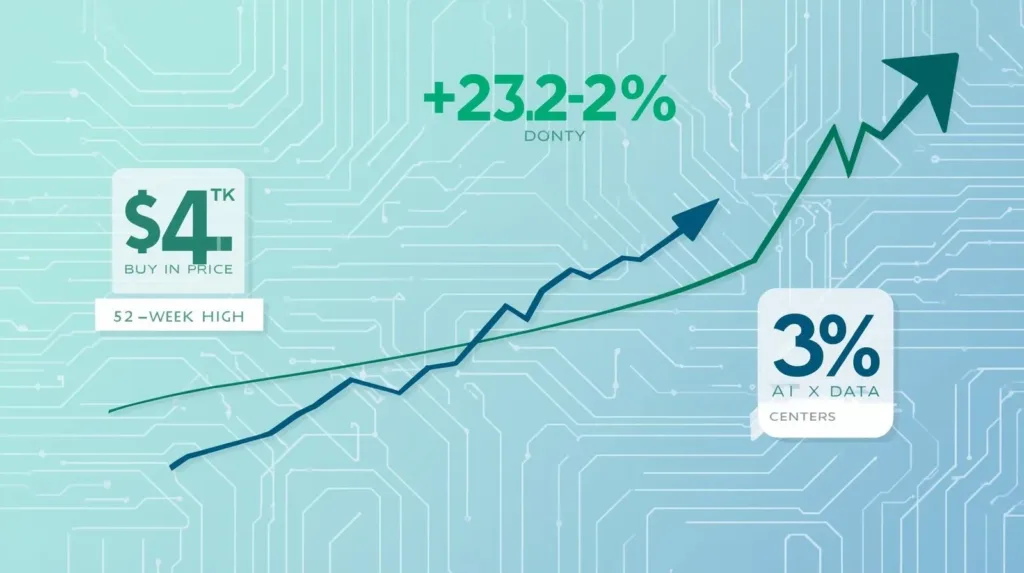
For most of the past decade, Intel (NASDAQ: INTC) has been fighting a two‑front war: catching up in manufacturing while defending CPU share from AMD and watching NVIDIA dominate accelerated computing. In September 2025, the plot twisted: NVIDIA announced a $5 billion investment in Intel (common stock at $23.28 per share) alongside a multi‑generation product collaboration spanning custom data‑center and PC silicon. Intel shares spiked more than 20% and notched a fresh 52‑week high near $31.8, signaling a wholesale rethink of Intel’s place in the AI stack. Yahoo Finance+3Newsroom+3Reuters+3
The partnership is not a merger, nor does it replace NVIDIA’s reliance on TSMC for its flagship GPUs. But it adds new lanes: Intel will design and manufacture custom x86 CPUs and client SoCs that integrate NVIDIA interconnects (e.g., NVLink) and RTX circuits, while the two companies co‑develop “multiple generations” of custom data‑center and PC products. The aim: pack more AI performance per watt and bring accelerated workflows to a wider set of users and form factors. Newsroom
Meanwhile, Intel has been reshaping its balance sheet—selling a 51% stake in Altera to Silver Lake—and trimming expense outlooks to bolster execution in its core roadmap. These moves, combined with the NVIDIA tie‑up, form the backbone of Intel’s 2025 “reset.” Reuters+1
What Exactly Did NVIDIA and Intel Agree To?
The Investment
- $5 billion into Intel common stock at $23.28 per share, announced Sept 18, 2025. Newsroom+1
The Product Roadmap (High Level)
- Co‑development of multiple generations of custom data‑center and PC products.
- Intel to design/manufacture custom data‑center and client CPUs, with NVIDIA NVLink and other RTX‑class technologies for tighter CPU‑accelerator coupling.
- Emphasis on AI infrastructure (cloud to enterprise) and client AI (PC). Newsroom
What It Is Not
- It does not (today) replace TSMC as the primary foundry for NVIDIA’s highest‑end GPUs; NVIDIA reiterated reliance on TSMC for those parts.
Why the Market Reacted: Three Big Unlocks
1) Validation in the AI Era
NVIDIA’s cash and collaboration are a strong external validation of Intel’s relevance in AI computing—especially in custom silicon where CPU, memory, IO, and accelerators must be composed for specific workloads. For investors, this is a bet that Intel’s platform engineering and advanced packaging can speed up the delivery of AI‑optimized systems. Newsroom
2) A Broader Customer and Product Surface
By co‑developing data‑center and PC products with NVIDIA tech, Intel opens new channels (think hyperscalers, OEMs, and enterprises that standardize on NVIDIA software stacks) and rekindles PC enthusiasm with client‑side AI acceleration. The market quickly priced in higher optionality, vaulting the stock to a 52‑week high after the news. Investing.com
3) Financial and Strategic Breathing Room
Intel’s Altera stake sale (51% to Silver Lake) helps streamline operations and refocus investment where it counts. The company subsequently trimmed expense guidance, a concrete step toward rebuilding margin structure during a demanding node transition. Reuters+1
INTC Stock: The Setup Going Into 2026
- Reaction: On the announcement, Intel jumped ~23–24% in a single session and helped push major U.S. indexes to record closes. NVIDIA also rose a few percent, while AMD dipped modestly on the day. Barron’s+1
- Range and Momentum: Intel posted a 52‑week high near $31.77–$31.78 around the announcement window, versus mid‑$20s just days prior. Investing.com+1
- Macro Backdrop: AI capex remains robust, but the foundry arms race is capital‑intensive and cyclical, keeping execution risk front and center for any turnaround. (General industry context; see Reuters timeline for Intel’s recent challenges.) Reuters
How the Partnership Could Play Out (Scenarios)
Data‑Center “Composable” AI Systems
Expect the duo to chase lower system bottlenecks via CPU–accelerator coherency (NVLink‑enabled pathways), balanced memory hierarchies, and better power/performance density. If Intel can deliver predictable cadence on nodes and packages, OEMs could field more application‑specific AI servers at attractive TCO. Newsroom
Client PCs With Real Local AI
On PCs, AI‑capable client SoCs that tap RTX‑class IP could turbocharge creator workflows (video, 3D, generative media) and on‑device assistants—without always leaning on the cloud. If priced well, this can re‑accelerate upgrade cycles. Newsroom
Foundry Implications
Even if NVIDIA keeps its flagship GPUs at TSMC, success here gives Intel credibility as a design + manufacturing co‑creator for custom silicon—a lane adjacent to, not replacing, NVIDIA’s mainstream GPU pipeline. That credibility can attract other custom‑silicon deals.
The Turnaround Levers at Intel
Portfolio Discipline
- Altera stake sale deconsolidates a loss‑making unit and raises cash. The strategy: focus on the core CPU, client, and data‑center roadmaps where co‑dev with NVIDIA could multiply returns. Reuters
Cost Control & Operating Model
- Lower expense outlook post‑Altera move underpins a healthier cost base going into node ramps. While cost cuts alone don’t revive technology leadership, they extend runway for the roadmap to land. Investopedia
Signaling to Customers
- With NVIDIA’s public vote of confidence, Intel’s customer narrative shifts from “can they deliver?” to “how fast can this co‑development show up in our racks and laptops?” That shift matters in enterprise and OEM cycles. Newsroom
Key Risks (Read Before You Romanticize the Comeback)
| Risk | Why It Matters |
|---|---|
| Execution risk | Intel’s turnaround hinges on hitting manufacturing nodes, packaging yields, and firm product cadence—slips would blunt the partnership’s impact. |
| Competitive pressure | AMD keeps pressing x86 CPUs; NVIDIA dominates accelerators; ARM designs creep into servers and clients; TSMC remains the process leader. |
| Regulatory and geopolitics | Export rules and China dynamics can alter TAM and supply chain assumptions quickly. |
| Cyclicality | Semiconductors swing with macro capex cycles; AI demand is strong, but not immune to digestion phases. |
(Context supported by market reports and Reuters industry coverage.) Reuters
Pros and Cons at a Glance
| Pros | Cons |
|---|---|
| $5B NVIDIA investment + multi‑gen co‑dev signals strategic validation and new product lanes. Newsroom | Node and packaging execution must improve and stay on cadence; any slippage risks credibility. |
| 52‑week‑high momentum shows investors repricing optionality. Investing.com | Competition from AMD/ARM/TSMC and NVIDIA’s existing platforms remains intense. |
| Balance‑sheet and cost work (Altera sale; expense trims) support focus. Reuters+1 | No guaranteed foundry win from NVIDIA’s core GPU line; reliance on TSMC persists. |
Who Might Consider INTC (and Who Might Not)
Potential Fit
- Long‑term investors who want diversified exposure to AI infrastructure + client AI beyond pure‑play accelerators.
- Value/turnaround investors who believe operational discipline + a marquee partner can re‑rate a legacy leader.
Maybe Not a Fit
- Short‑term momentum traders expecting linear gains—turnarounds zig‑zag.
- Pure‑play AI chasers who want maximum accelerator beta (they’ll likely stick with NVDA or other AI‑first names).
What to Watch Next (Practical Checklist)
- Product reveal cadence from the co‑development roadmap (benchmarks, timelines, OEM design wins). Newsroom
- Quarterly updates on expense trajectory and margin rebuild, post‑Altera. Investopedia
- Manufacturing milestones: yields, node ramps, and packaging throughput.
- Customer signals: hyperscaler deployments, PC attach rates for AI‑capable client parts.
- Macro & policy: export rules and any shifts in government support for domestic chipmaking.
Frequently Asked Questions (FAQ)
1) Does NVIDIA’s $5B buy mean it will manufacture its GPUs at Intel?
No. NVIDIA reiterated reliance on TSMC for its top‑end GPUs. The Intel partnership focuses on co‑developed custom data‑center and PC products and on Intel designing/manufacturing custom CPUs and SoCs with NVIDIA interconnects. Newsroom
2) Why did Intel’s stock jump so much on the news?
Because the market views NVIDIA’s investment and roadmap tie‑up as a strong signal of confidence in Intel’s technology and execution path. The news pushed INTC to a 52‑week high and helped lift broader indexes. Investing.com+1
3) What’s the significance of the Altera stake sale?
It raises cash, simplifies reporting (deconsolidation), and refocuses resources on the core roadmap. It also supported lower expense guidance—a key input to the turnaround. Reuters+1
4) Could this be the first step toward a larger corporate tie‑up?
There’s no official indication of M&A between the two. Analysts are speculating, but as of now it is an equity investment + product collaboration. Stick to what’s announced. Newsroom
5) Is INTC now a pure AI stock?
No. Intel is a broad‑platform company (PCs, data‑center CPUs, networking, and foundry ambitions). The deal increases Intel’s AI exposure, but it doesn’t make INTC a pure accelerator play like NVIDIA. Newsroom
Bottom Line
Intel’s 2025 story is no longer just about catching up—it’s about partnering up. A $5B NVIDIA investment plus a multi‑gen product collaboration reframes Intel as a co‑creator of AI systems across data centers and PCs. Execution remains the gating factor, but the optionality just expanded—and the market noticed.