

Plug Power (NASDAQ: PLUG) is a U.S. clean‑energy company focused on fuel cells, electrolyzers, and green hydrogen infrastructure. For the latest quarterly details, see the company’s Investor Relations. If you’re new to compounding and position sizing, start with Compound Interest Simple Practical Guide 2025 and Budgeting Tools For Beginners
Table of Contents
1. Company Overview
Plug Power, Inc. is an American company operating in the clean energy sector, specializing in:
- Fuel cells
- Electrolyzers
- Hydrogen infrastructure systems
Headquartered in Latham, New York, Plug Power has production and development facilities in multiple locations.
Using its technology, the company aims to replace or support traditional batteries, especially in:
- Material handling systems
- Backup power stations
- Vehicles and applications that benefit from green hydrogen generation
2. Recent Financial Performance
Here are the key highlights from recent quarters, focusing on Q2 2025:
| Item | Reported | YoY Comparison |
|---|---|---|
| Revenue (Q2 2025) | ~$174 million | ~+21% vs. Q2 2024 |
| Gross Margin | Improved from −92% (Q2 2024) to ≈ −31% (Q2 2025) | |
| Operating Expenses & Non-Cash Items | “Project Quantum Leap” is ongoing, aimed at cutting costs via supply improvements, plant consolidation, and reducing overhead. | |
| Cash Flow | Still negative, but cash burn reduced compared to previous quarters. | |
| Liquidity | Over $140M in unrestricted cash at end of Q2 2025, with access to ~$300M in additional debt facilities. |

3. What’s Driving the Stock Now?
Several combined factors help explain the recent surge in Plug Power’s stock price, even without major news:
Potential Short Squeeze
- Short interest is extremely high (30–40% of float).
- Investors who bet against the stock could be forced to buy back as prices rise, adding fuel to the rally.
Interest Rate Cuts
- The Fed’s rate cuts benefit companies like Plug Power that rely on external financing and are not yet profitable.
Source: Barron’s
Operational Margin Improvements – “Project Quantum Leap”
- The company is restructuring to cut operational costs, optimize supply chains, and reduce waste.
- Electrolyzer revenue is growing fast and is seen as key to long-term scalability.
Policy Support and Green Incentives
- U.S. federal laws promoting clean energy and green hydrogen give Plug Power a favorable policy backdrop.
Source: Nasdaq
4. Key Risks and Challenges
Despite strong potential, investors should be aware of the following:
| Challenge | Description |
|---|---|
| Ongoing Losses | Plug Power has yet to report any operating or net profits and continues to burn cash. |
| Negative Margins | Although improving, gross margins are still negative (~−31%), meaning product costs exceed revenues. |
| High Capital Needs | Constant funding is required to support growth, infrastructure, and R&D. Expensive or limited financing could hurt operations. |
| Policy Dependence | Much of the company’s future hinges on government incentives and legislation, which could change. |
| Technological Competition | Other firms in hydrogen, battery, EV, and renewable energy sectors are competing aggressively. |
| Volatility & Speculative Risks | The stock is subject to strong price swings driven by market sentiment and short-term speculation. |

5. Future Outlook
Here’s what analysts and the company are projecting:
- Profitability Goals:
Operating profit by end of 2027, and net profitability by end of 2028.
- Gross Margin Improvement:
Expected to reach break-even (neutral) gross margin by end of 2025 due to restructuring and cost control.
- Revenue Growth:
Continued 20–25% annual growth is expected if contracts are secured and operational efficiencies improve. Both public and private sectors are increasing green hydrogen adoption.
- Market Momentum:
Recent price rallies reflect strong sentiment and interest in clean energy plays. However, without real operational improvements, such momentum may not last.
6. Valuation
Analyst sentiment on Plug Power is mixed:
| Metric | Value |
|---|---|
| Current Price Range | ~$2–$3 (as of late Sept 2025) |
| Target Price (Craig-Hallum) | Raised to $4.00 citing improving margins and execution |
| Caution | Some analysts warn that valuation may be too optimistic given the ongoing losses and dependency on projections |
7. When Might It Be a Smart Buy?
If you’re considering investing or trading Plug Power, here’s a suggested approach:
- Entry Timing:
Consider entering on a dip or correction, rather than chasing a parabolic rally. - Stop Loss Strategy:
Use defined loss limits (e.g., 20–30%) to avoid deep drawdowns due to volatility. - Diversification:
Make PLUG a small part of a broader clean energy or tech portfolio. - Follow News & Earnings Closely:
Rely on quarterly reports and policy updates to guide re-evaluation. - Time Horizon:
Medium-to-long-term (2–3+ years) if betting on a turnaround; short-term if playing momentum.
8. Conclusion
Plug Power is moving in a promising direction in the green hydrogen and clean energy space, benefitting from rising global demand and favorable government policies.
Its recent financials show marked improvements, especially in revenue and margin reduction. However, the company still operates at a loss and consumes cash at a notable rate.
The recent rally appears partially driven by a short squeeze and speculative interest, not just fundamental shifts. The road to profitability remains long and dependent on disciplined execution.
If you’re a medium-risk investor with a long view, PLUG may be worth exploring. But it’s vital to analyze the current price carefully and have contingency plans if projections don’t materialize.
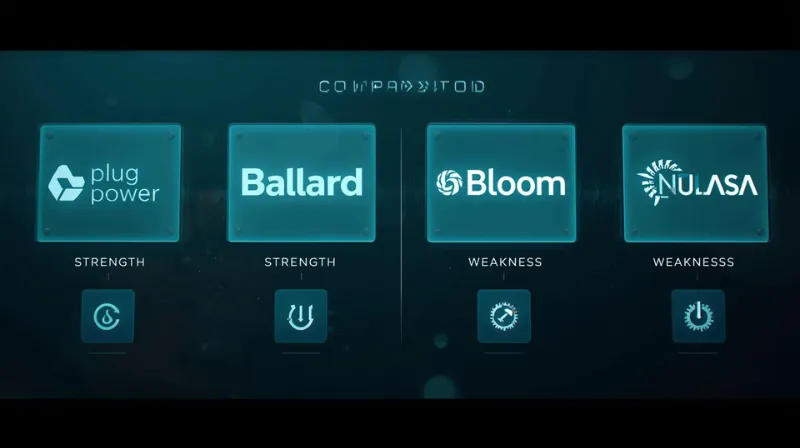
Competitor Comparison: Plug Power vs. Top Hydrogen and Clean Energy Companies
In this section, we compare Plug Power with leading players in the hydrogen and renewable energy sector in terms of growth, profitability, strategy, and risk.
1. Plug Power (NASDAQ: PLUG)
| Item | Details |
|---|---|
| Core Business | Fuel cells, green hydrogen production, infrastructure |
| Financial Status | Operating losses, negative margins, limited liquidity |
| Strengths | Global expansion, partnerships with Amazon and Walmart, major investment in electrolyzers |
| Weaknesses | Cash burn, high reliance on funding and government support |
2. Ballard Power Systems (NASDAQ: BLDP)
| Item | Details |
|---|---|
| Core Business | Fuel cells for heavy-duty transport and infrastructure |
| Location | Canada |
| Profitability | Not profitable but burns less cash than Plug Power |
| Strengths | Focus on heavy transport (buses, trucks) |
| Weaknesses | Slow contract wins, limited geographic expansion |
3. Bloom Energy (NYSE: BE)
| Item | Details |
|---|---|
| Core Business | Stationary energy systems based on solid-oxide fuel cells (alternative to generators) |
| Profitability | Near break-even, sometimes reports positive gross margins |
| Strengths | Strong public/private contracts, institutional client base |
| Weaknesses | Large-scale projects require heavy capital, faces solar energy competition |
4. Nel ASA (OSE: NEL)
| Item | Details |
|---|---|
| Core Business | Electrolyzers for hydrogen production |
| Location | Norway |
| Strengths | Long-standing expertise, EU government support, global reach |
| Weaknesses | Currency volatility, weak profitability, heavy dependence on European market |
Quick Comparison Table
| Company | Profitable? | Key Strength | Key Risk |
|---|---|---|---|
| Plug Power | ❌ No | Expansion + strong partnerships | Cash burn, policy reliance |
| Ballard | ❌ No | Heavy transport specialization | Slow growth |
| Bloom Energy | ❌ (Near) | Positive margins + big clients | Capital-intensive projects |
| Nel ASA | ❌ No | Electrolyzer market leader | EU market dependence |
Summary
- Plug Power has a bold vision and wide market focus, but faces serious liquidity and profitability challenges.
- Ballard is more specialized but shows slower expansion.
- Bloom Energy appears closer to financial stability, supported by institutional contracts.
- Nel ASA is technically strong and supported in Europe, but may not suit all global investors.
Worst-Case Risk Scenario for Plug Power (High-Level Risk Analysis)
While Plug Power holds long-term promise in the hydrogen space, a number of things could go wrong. Here’s a breakdown of what the worst-case scenario might look like if key financial, operational, or policy milestones are not met:
1. Ongoing Cash Burn Without Recovery (Burnout Scenario)
- Situation: The company continues to burn cash at a high rate without meaningful improvements in revenue or margins.
- Impact: Repeated fundraising becomes necessary, leading to:
- Shareholder dilution
- Expensive or unavailable capital
- Outcome: Risk of bankruptcy or forced restructuring due to debt pressure.
2. Failure of “Project Quantum Leap”
- Situation: Plug Power fails to execute its cost-cutting and supply chain optimization strategy.
- Impact: Gross margins remain negative; break-even remains out of reach.
- Outcome: Market loses confidence in Plug Power’s ability to turn profitable.
3. Political Shifts Reduce Green Incentives
- Situation: U.S. federal support for green hydrogen is reduced or redirected toward solar and battery tech.
- Impact: Green hydrogen becomes less economically attractive.
- Outcome: Revenue pipeline shrinks, and new projects stall.
4. Collapse in Stock Price Due to Confidence Erosion
- Situation: After repeated earnings disappointments, institutional and retail investors begin a massive sell-off.
- Impact: Stock drops below $1, risking NASDAQ delisting.
- Outcome: Recovery becomes extremely difficult, and institutional investment dries up.
5. Technological Disruption from Rivals
- Situation: More cost-efficient or scalable hydrogen competitors emerge.
- Impact: Plug Power loses competitive edge, even in segments it pioneered.
- Outcome: Market share declines and Plug struggles to regain momentum.
How Can Investors Mitigate This Risk?
- Use Stop Losses: Set predefined exit points (e.g., 20–25%) to protect capital.
- Monitor Quarterly Reports Closely: Focus on margins, revenue growth, and cost reduction progress.
- Track Cash Position & Capital Needs: Especially burn rate and funding plans.
- Watch Policy Trends: Follow U.S. legislation on clean energy incentives closely.